LightX2V x FlagOS: A Plugin Design for Cross-Chip Video Generation Inference
Video generation inference is increasingly a cross-chip deployment problem. Modern DiT pipelines depend on optimized Attention, quantized MatMul, normalization, RoPE, and distributed communication kernels; when the target accelerator changes, those hot paths often need to be adapted again.
This post introduces the lightx2v-plugin-FL integration: an out-of-tree
LightX2V backend powered by FlagOS. It complements LightX2V’s existing
per-chip in-tree platform mechanism by registering a single meta-platform:
PLATFORM=flagos
Under this platform, LightX2V continues to use its existing model runners, schedulers, offload logic, and config-driven operator registries. FlagOS handles the heterogeneous substrate through FlagGems for compute operators and FlagCX for collective communication where available.
The integration is designed around four goals:
- One backend, multiple chips: expose
flagosas a LightX2V platform while delegating physical chip coverage to the FlagOS stack. - No LightX2V fork: keep the integration in a pip-installable plugin rather than editing LightX2V model code.
- Config-driven operator selection: reuse LightX2V’s existing registry keys for Attention, MatMul, Norm, and RoPE.
- Graceful fallback: prefer FlagGems kernels, but keep torch reference paths for development, smoke tests, and missing operator coverage.
Table of contents:
- Why a FlagOS Plugin
- Integration Overview
- Core Mechanisms
- Operator Coverage
- Quick Start
- Practical Recommendations
- DreamZero Validation: Native vs FlagOS
- Limitations and Next Steps
- Resources
Why a FlagOS Plugin
LightX2V already separates hardware-specific logic into lightx2v_platform.
That layer initializes devices, registers chip-specific operators, and lets the
upper inference stack stay mostly hardware-agnostic. This is LightX2V’s original
platform mechanism and remains its main in-tree integration path: each chip is
typically supported by a dedicated backend implementation.
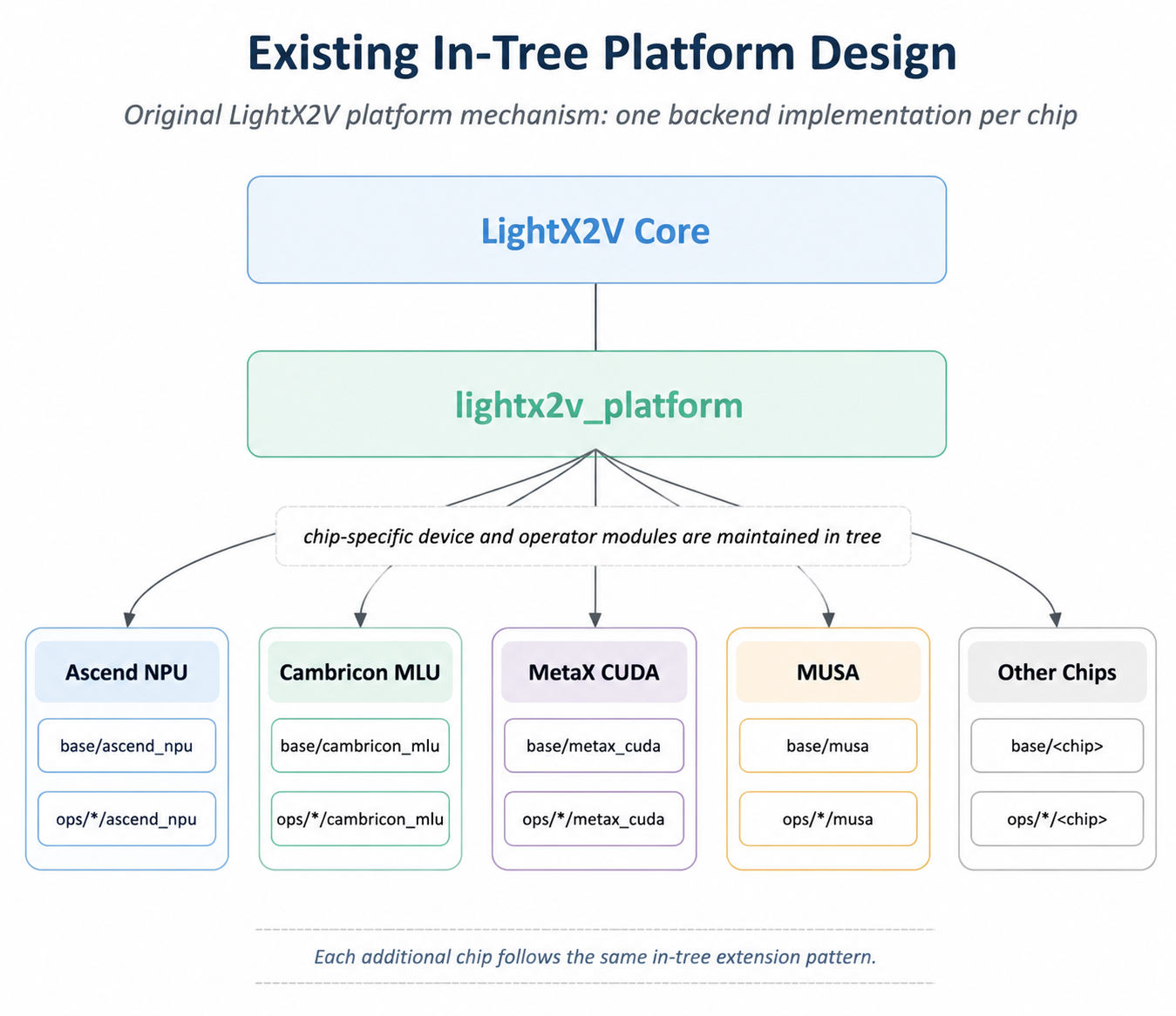
Figure 1: Existing LightX2V in-tree platform design. Chip-specific device and
operator modules are maintained under lightx2v_platform, and each additional
chip follows the same in-tree extension pattern.
In practice, supporting another accelerator may require a new base/<chip>
device adapter, corresponding ops/*/<chip> implementations, configuration
files, launch scripts, and numerical validation. Even when two chips run the
same video generation model, their operator APIs and communication backends may
differ, so this per-chip work can become repetitive as the hardware matrix
grows.
FlagOS is built to address this fragmentation. In the 2.1 release, it provides a cross-chip heterogeneous AI system software stack, including:
- FlagGems: a large-scale operator library with broad chip coverage.
- FlagTree: a cross-chip compiler layer.
- KernelGen: an automated operator generation platform.
- FlagScale Agent: tooling for automated model migration, accuracy alignment, and performance optimization.
- FlagCX: a collective communication layer that can plug into PyTorch distributed execution.
For LightX2V inference, the key idea is simple: make FlagOS the platform
boundary. LightX2V sees PLATFORM=flagos; FlagOS absorbs the chip matrix below
that boundary.
Integration Overview
lightx2v-plugin-FL is intentionally small. It does not replace the LightX2V
pipeline or introduce a separate inference engine. It contributes a Python
package, lightx2v_fl, whose register() function wires the FlagOS backend
into LightX2V’s normal extension points.
Figure 2 shows how that boundary appears at runtime. The user selects
PLATFORM=flagos and the flagos_* operator keys through configuration, while
LightX2V continues to own the runner, scheduler, and offload workflow.
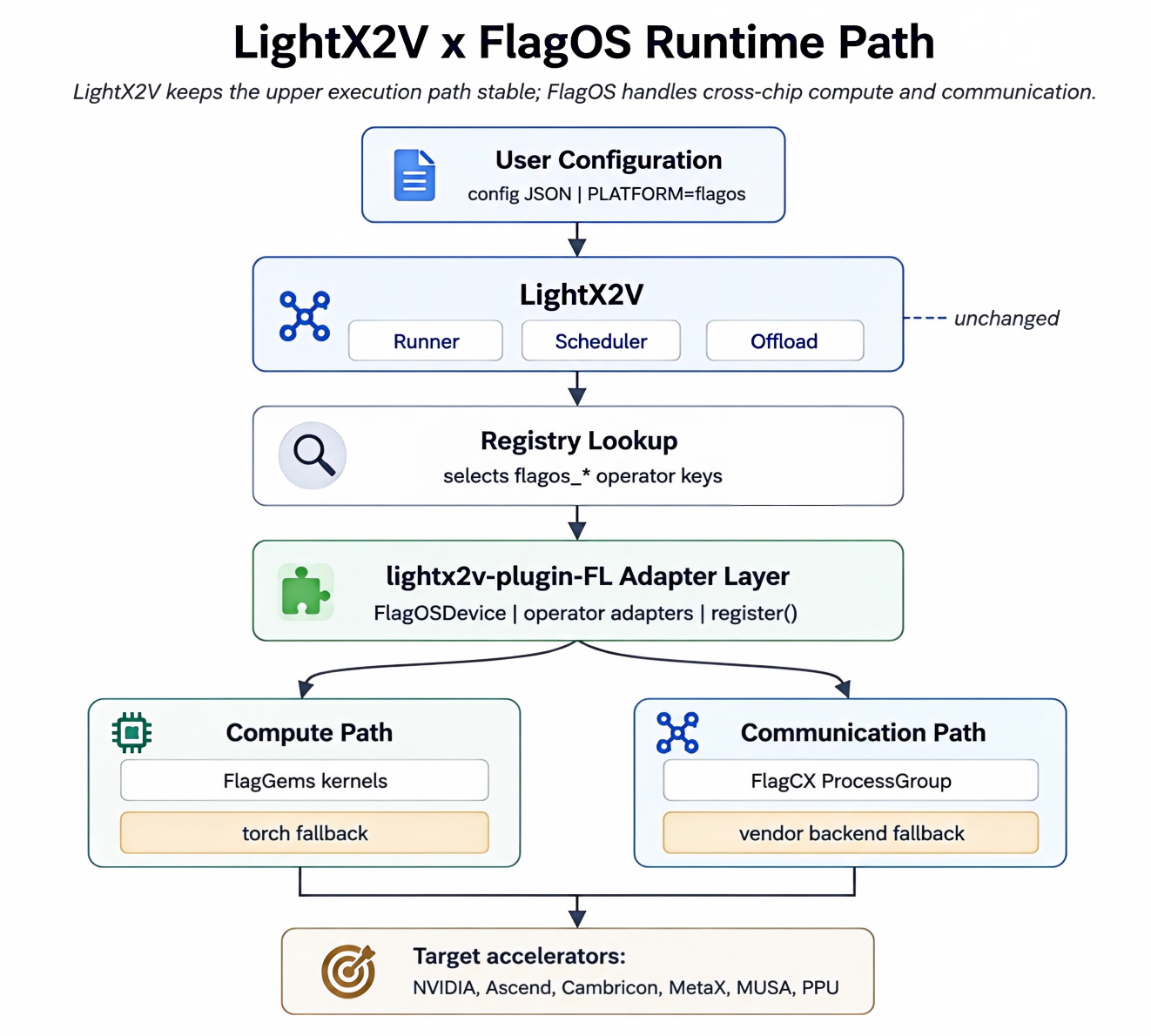
Figure 2: LightX2V x FlagOS runtime path. Registry lookup selects the FlagOS operator adapters; the plugin then routes compute to FlagGems with torch fallbacks, and distributed communication to FlagCX with vendor-native backend fallbacks.
The two lower branches isolate the hardware-dependent work. Both ultimately target the concrete accelerator detected by the FlagOS environment, while the upper LightX2V execution path remains unchanged.
The plugin repository is organized around the same functional boundaries as LightX2V’s platform layer:
| Path | Role |
|---|---|
lightx2v_fl/__init__.py |
Idempotent register() entry point and optional auto-registration. |
lightx2v_fl/device/ |
FlagOSDevice, registered as flagos and fl. |
lightx2v_fl/ops/attn.py |
flagos_flash_attn. |
lightx2v_fl/ops/mm.py |
flagos, flagos-fp8, and flagos-int8 MatMul schemes. |
lightx2v_fl/ops/norm.py |
flagos_rms_norm and flagos_layer_norm. |
lightx2v_fl/ops/rope.py |
flagos_rope. |
lightx2v_fl/configs/ |
Ready-to-use Wan T2V configs for FlagOS. |
Dockerfile_ppu_flagos |
Example PPU-ZW810E image build with LightX2V, FlagGems, FlagCX, and the plugin. |
This structure keeps the plugin easy to audit: device, operator, config, and packaging concerns are separate, and each operator adapter is thin.
Core Mechanisms
1. A flagos Meta-Platform
The plugin registers one LightX2V platform key:
PLATFORM=flagos
PLATFORM=fl       # alias
FlagOSDevice detects the concrete torch device by asking FlagGems first, then
probing common torch backends such as cuda, npu, mlu, musa, and xpu.
This lets the LightX2V side stay stable even when the physical device changes.
2. Entry-Point Activation with an Import Fallback
The package exposes a standard Python entry point:
[project.entry-points."lightx2v.platform_plugins"]
flagos = "lightx2v_fl:register"
Once LightX2V loads this entry-point group during platform initialization, installing the plugin is enough. Until that hook is available in a given checkout, users can explicitly import the plugin before entering LightX2V:
python -c "import lightx2v_fl; from lightx2v.infer import main; main()" \
  <lightx2v-infer-arguments>
The register() function is idempotent, so it is safe to call from either path.
3. Registry Timing: Device vs Operators
LightX2V merges platform operator registries into final runtime registries at
import time. Because that merge is a snapshot, a late plugin registration into
the staging PLATFORM_* operator tables may be invisible to model code.
The FlagOS plugin therefore uses a split strategy:
- The device registers into
PLATFORM_DEVICE_REGISTER, becauseset_ai_device()must findflagosduring platform initialization. - The operators register directly into the final LightX2V registries:
ATTN_WEIGHT_REGISTER,MM_WEIGHT_REGISTER,RMS_WEIGHT_REGISTER,LN_WEIGHT_REGISTER, andROPE_REGISTER.
Figure 3 separates registration from lookup. Importing lightx2v_fl first
registers FlagOSDevice and the flagos_* operators; it may also enable the
optional process-wide FlagGems patch. LightX2V then initializes the selected
platform and resolves the config-selected operators from those populated
registries.
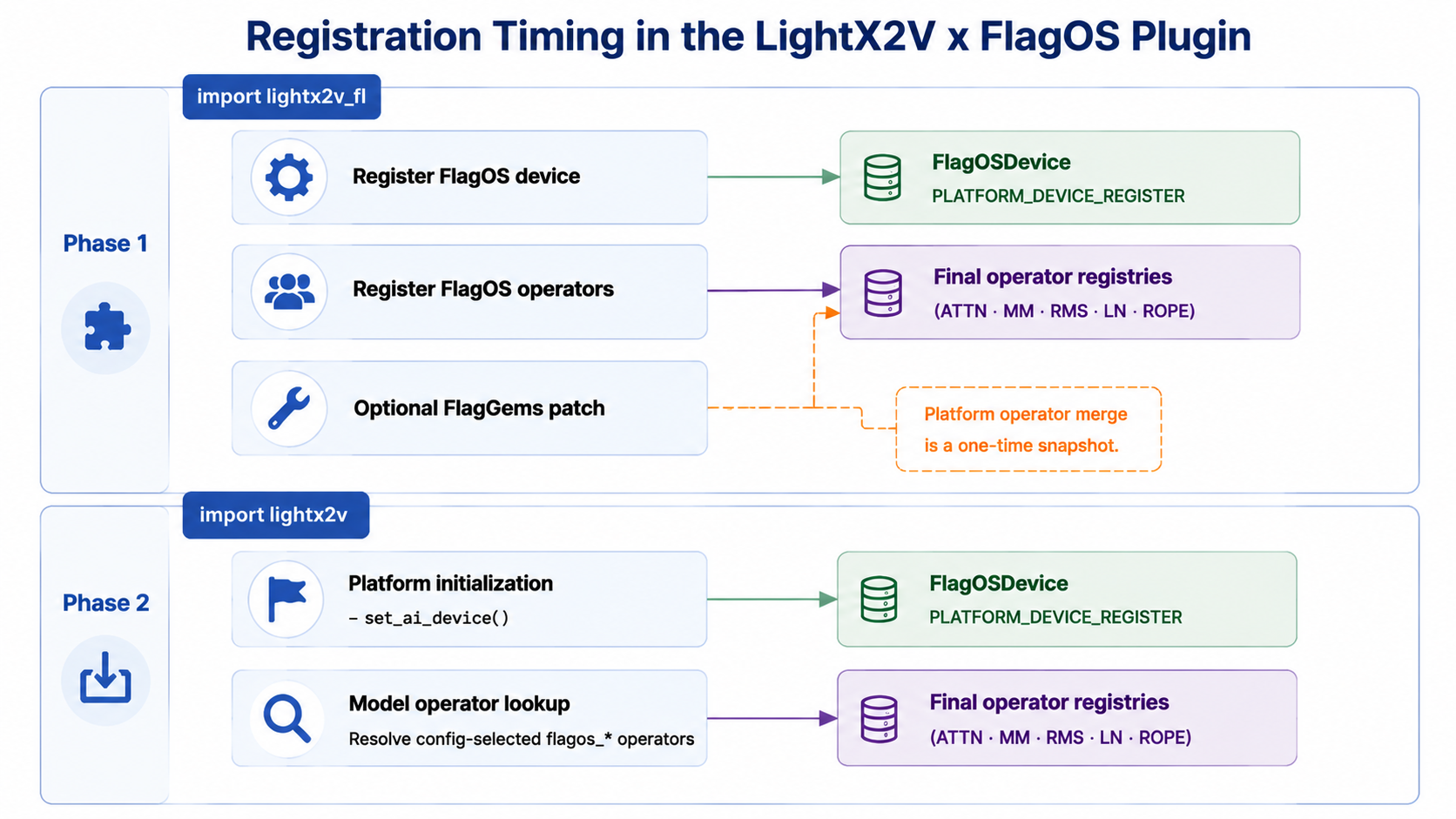
Figure 3: Registration timing in the LightX2V x FlagOS plugin. Phase 1 writes
the device and operator entries; Phase 2 reads FlagOSDevice during platform
initialization and looks up operators in the final runtime registries.
The FlagOSDevice box in Phase 2 is therefore the lookup target established in
Phase 1, not a second registration step. This split registration strategy avoids
platform-registry snapshot-order issues and lets the plugin remain an
out-of-tree package without forking LightX2V.
4. FlagCX First, Vendor Backend Fallback
For distributed inference, the plugin prefers FlagCX when it can be imported:
cpu:gloo,<device>:flagcx
If FlagCX is not installed, or if users set
LIGHTX2V_FL_DISABLE_FLAGCX=1, the plugin falls back to the vendor-native
backend:
| Torch device | Fallback backend |
|---|---|
cuda |
nccl |
npu |
hccl |
mlu |
cncl |
musa |
mccl |
xpu |
ccl |
This keeps the single-card path lightweight while giving multi-card deployments a clean route to FlagCX.
Operator Coverage
The current plugin focuses on the core DiT operator path used by Wan-style video generation:
| LightX2V config field | FlagOS value |
|---|---|
self_attn_1_type |
flagos_flash_attn |
cross_attn_1_type |
flagos_flash_attn |
cross_attn_2_type |
flagos_flash_attn |
rms_norm_type |
flagos_rms_norm |
layer_norm_type |
flagos_layer_norm |
rope_type |
flagos_rope |
dit_quant_scheme |
flagos, flagos-fp8, or flagos-int8 |
The implementation policy is consistent: try FlagGems first, then fall back to a torch reference path when needed.
Attention
flagos_flash_attn adapts LightX2V’s WAN-style attention layout and probes
FlagGems attention entry points. If the FlagGems call is unavailable or fails,
it falls back to torch.nn.functional.scaled_dot_product_attention.
MatMul and Quantized MatMul
The plugin registers:
flagosfor BF16/FP16 linear layers.flagos-fp8for FP8 per-channel symmetric stored weights.flagos-int8for INT8 per-channel symmetric stored weights.
The quantized paths reuse LightX2V’s existing MMWeightQuantTemplate loaders,
so model weight formats remain aligned with the rest of the framework.
Normalization and RoPE
flagos_rms_norm and flagos_layer_norm call FlagGems normalization operators
when present and otherwise use torch references. flagos_rope adapts
LightX2V’s [S, H, D] query/key layout to the layout expected by FlagGems,
then restores the original layout after rotary embedding.
Quick Start
As one concrete hardware example, the plugin provides a Docker image for the PPU-ZW810E platform:
docker pull lightx2v/lightx2v-plugin-fl:26070101-platform-ppu
Start a container with your model mounted. Add the device flags required by the PPU-ZW810E runtime or your cluster scheduler.
mkdir -p outputs

docker run --rm -it \
  --ipc=host \
  --network=host \
  -v /path/to/Wan2.1-T2V-14B:/models/wan2.1-t2v:ro \
  -v "$PWD/outputs:/workspace/LightX2V/save_results" \
  lightx2v/lightx2v-plugin-fl:26070101-platform-ppu \
  bash
Run Wan2.1 T2V with the FlagOS config:
cd /workspace/LightX2V

export PLATFORM=flagos

python -c "import lightx2v_fl; from lightx2v.infer import main; main()" \
  --model_cls wan2.1 \
  --task t2v \
  --model_path /models/wan2.1-t2v \
  --config_json /workspace/lightx2v-plugin-FL/lightx2v_fl/configs/wan_t2v_flagos.json \
  --prompt "A cinematic shot of a futuristic research lab where a robot arm assembles a tiny glowing aircraft." \
  --negative_prompt "low quality, blurry, distorted, watermark, text" \
  --save_result_path /workspace/LightX2V/save_results/wan_t2v_flagos.mp4
For source installation, install LightX2V, the plugin, and the FlagOS runtime packages in the same environment:
git clone https://github.com/ModelTC/LightX2V.git
cd LightX2V
pip install -e .

cd /path/to/lightx2v-plugin-FL
pip install -e .

# Install the FlagGems build matching your chip; NVIDIA shown as an example.
pip install "flag_gems[nvidia]"
For FP8 inference, switch the config to:
lightx2v_fl/configs/wan_t2v_flagos_fp8.json
For multi-card inference, install or enable FlagCX and launch with torchrun.
Once the LightX2V entry-point hook is available, the command can use the normal
module form:
export PLATFORM=flagos

torchrun --nproc_per_node=2 -m lightx2v.infer \
  --model_cls wan2.1 \
  --task t2v \
  --model_path /path/to/Wan2.1-T2V-14B \
  --config_json /path/to/lightx2v-plugin-FL/lightx2v_fl/configs/wan_t2v_flagos.json \
  --prompt "A high-speed train crossing a mountain bridge at sunset." \
  --save_result_path save_results/wan_t2v_flagos_dist.mp4
To verify plugin wiring without real accelerator kernels:
cd /path/to/lightx2v-plugin-FL
pytest -q
These smoke tests cover registration and torch fallback correctness. Real FlagGems kernels, FlagCX collectives, and FP8/INT8 numerical behavior should still be validated on the target chip.
Practical Recommendations
Start with the Registry Path
Use the explicit FlagOS config keys first:
{
  "self_attn_1_type": "flagos_flash_attn",
  "cross_attn_1_type": "flagos_flash_attn",
  "cross_attn_2_type": "flagos_flash_attn",
  "rms_norm_type": "flagos_rms_norm",
  "layer_norm_type": "flagos_layer_norm",
  "rope_type": "flagos_rope"
}
This path is easy to debug because operator selection is visible in the config.
Enable Global FlagGems Patching Carefully
The plugin can optionally call flag_gems.enable() for generic torch ops that
do not pass through LightX2V’s weight-template registries:
export LIGHTX2V_FL_GLOBAL_GEMS=1
Because this changes torch behavior process-wide, enable it after the registry path is already correct and benchmark it per model and chip. If a patched op regresses, exclude it:
export LIGHTX2V_FL_GEMS_UNUSED=softmax,gelu
Debug with the Smallest Checks First
If PLATFORM=flagos is not recognized, check device registration:
python - <<'PY'
import lightx2v_fl
from lightx2v_platform.registry_factory import PLATFORM_DEVICE_REGISTER

print("flagos" in PLATFORM_DEVICE_REGISTER)
print("fl" in PLATFORM_DEVICE_REGISTER)
PY
If an operator key is missing, check the final runtime registries:
python - <<'PY'
import lightx2v_fl
from lightx2v.utils.registry_factory import ATTN_WEIGHT_REGISTER, MM_WEIGHT_REGISTER

print("flagos_flash_attn" in ATTN_WEIGHT_REGISTER)
print("flagos-fp8" in MM_WEIGHT_REGISTER)
PY
If FlagCX is not available, the plugin falls back to the vendor-native backend. To disable FlagCX intentionally:
export LIGHTX2V_FL_DISABLE_FLAGCX=1
DreamZero Validation: Native vs FlagOS
DreamZero extends the initial Wan T2V validation to an I2VA robotics workload. The experiment below compares the native LightX2V execution path with the FlagOS plugin on the same PPU-ZW810E accelerators. All model, input, sampling, and parallelism settings are held constant so that the backend is the only intended variable.
Experimental Setup
| Item | Configuration |
|---|---|
| Hardware | PPU-ZW810E, 97,920 MiB per device |
| Number of devices | 2 |
| Model | DreamZero-DROID |
| Task | I2VA |
| Input | DROID three-camera observation |
| Prompt | Move the pan forward and use the brush in the middle of the plates to brush the inside of the pan |
| Resolution | 640 × 352 |
| Video inference steps | 16 |
| Action inference steps | 16 |
| Seed | 1140 |
| Parallelism | CFG parallelism, size 2 |
| PPU driver / HGGC version | 1.3.2-d7f5a2 / 13.0 |
| LightX2V commit | 6aa6795 |
lightx2v-plugin-FL commit |
b152204 |
| FlagGems version | 5.0.2+v0.1.0.ppu2.1.0.ce |
| Container image | lightx2v-fl:ppu-flagos (local experiment image) |
Both backends use the same model, input, seed, precision, and parallel settings. After one warm-up run, each backend is measured three times.
Backend Configuration
| Mode | LightX2V platform | Operator path |
|---|---|---|
| Native PPU | cuda |
Existing DreamZero operators |
| FlagOS on PPU | flagos |
DreamZero-compatible FlagOS adapters and FlagGems kernels |
The PPU runtime exposes a CUDA-compatible torch API, so PLATFORM=cuda denotes
the native PPU path rather than an NVIDIA GPU. FlagCX was disabled for both
backends, and distributed communication used the vendor NCCL implementation.
Results
| Backend | DiT time (3 runs) | Pipeline time (3 runs) |
|---|---|---|
| Native LightX2V on PPU | 78.53 ± 0.40 s | 81.53 ± 0.44 s |
| LightX2V + FlagOS on PPU | 85.34 ± 0.39 s | 88.35 ± 0.36 s |
Values are the mean ± sample standard deviation after one warm-up run. Both
backends successfully generated the DreamZero video and action outputs. The
FlagOS logs confirmed the flagos platform and FlagGems attention dispatch,
with no torch fallback reported.
This validates the DreamZero I2VA execution path through the plugin, but the current FlagOS implementation is not yet a performance optimization for this PPU configuration: the native path was faster in this experiment.
Visual Comparison
| Native LightX2V on PPU | LightX2V + FlagOS on PPU |
|---|---|
Both runs produced a 141-frame, 640 × 352 video at 5 FPS and a finite 384 × 8 action array. The outputs are not bit-identical, as expected from different operator implementations, but both complete the same DreamZero task with the same input and sampling configuration.
Limitations and Next Steps
The current plugin should be treated as an MVP integration path rather than a fully tuned backend for every FlagOS-supported chip. The important remaining work is hardware validation:
- confirm numerical alignment for Attention, RoPE, Norm, and quantized MatMul;
- benchmark FlagGems kernels against chip-native tuned kernels;
- validate FlagCX behavior under LightX2V parallel workloads;
- expand model coverage beyond the validated Wan T2V and DreamZero I2VA configurations;
- upstream the entry-point hook so
pip install lightx2v-plugin-flbecomes the normal activation path.
Even with those caveats, the design direction is useful: LightX2V keeps owning
the video inference pipeline, while FlagOS owns the cross-chip operator and
communication layer. As FlagOS coverage expands, the same PLATFORM=flagos
backend can reduce repeated per-vendor integration work and make cross-chip
video generation deployment more maintainable.