Graph Fusion for DiT Inference: Magi Compiler in LightX2V
In DiT inference for video and image generation, compute-heavy core operators often already have dedicated optimized kernels, yet many small operator chains still lack mature, efficient optimizations—memory traffic and kernel launch overhead remain non-trivial. Hand-written Triton can optimize hot spots in those chains, but each pattern requires separate development and maintenance; using torch.compile directly often yields unstable gains or even regressions when subgraph boundaries and dynamic shapes are not handled carefully.
This post introduces Magi Compiler integration in LightX2V—a torch.compile-based compilation stack tailored for Transformer-style inference. This integration lowers adoption and maintenance cost while delivering:
- Low engineering cost: packages subgraph boundaries, dynamic shapes, piecewise compilation, and other
torch.compileplumbing into a reusable integration path, reducing development and maintenance cost for graph-level compilation in LightX2V. - Steady-state speedups on pre-Triton paths: ~15–20% per-step improvement on NeoPP at steady state; ~20% on Qwen Image with Triton OFF; closes much of the gap to hand-tuned Triton (~93–94%).
- Multi-resolution serving on the compile path: within a single process, switching resolutions can reuse compiled subgraphs, avoiding repeated per-shape recompilation that inflates first-step latency.
We thank the SandAI team for developing and open-sourcing Magi Compiler, and for their pioneering integration work in LightX2V-MagiCompiler—their compiler design and reference implementation made this LightX2V integration possible.
Table of contents:
- Why DiT Inference Needs Magi Compiler
- Magi Compiler Integration in LightX2V
- Benchmarks and Recommendations
- Porting Magi Compiler to a New Model
- Limitations
Why DiT Inference Needs Magi Compiler
DiT inference tends to split into two worlds: FlashAttention, GEMM, MoE, and other large operators are already heavily optimized, while small operator chains—norm, RoPE, modulate, residual handling—still leave room for improvement.
Two common approaches target those small chains:
- Hand-fused kernels (e.g., Triton)
- Hot operator chains are rewritten as dedicated fused kernels; when patterns are fixed and tuning is thorough, performance is excellent.
- The cost is per-pattern development and maintenance; model structure changes often require new kernels or re-tuning.
- Compiler-driven fusion (e.g.,
torch.compile)- The compiler traces the computation graph and fuses operator chains automatically, without manual kernel work.
- On complex DiT graphs, however, gains are unstable or negligible without careful subgraph boundaries and dynamic-shape design; robust support for custom ops and dynamic shapes is itself a substantial engineering effort.
Magi Compiler follows the compiler-driven path. Built on torch.compile, it adds Transformer-oriented enhancements—subgraph boundary conventions, piecewise compilation, and declarative dynamic-shape configuration—packaged for easier, maintainable integration and lower engineering cost when enabling compilation in LightX2V.
Magi Compiler Integration in LightX2V
Integration overview
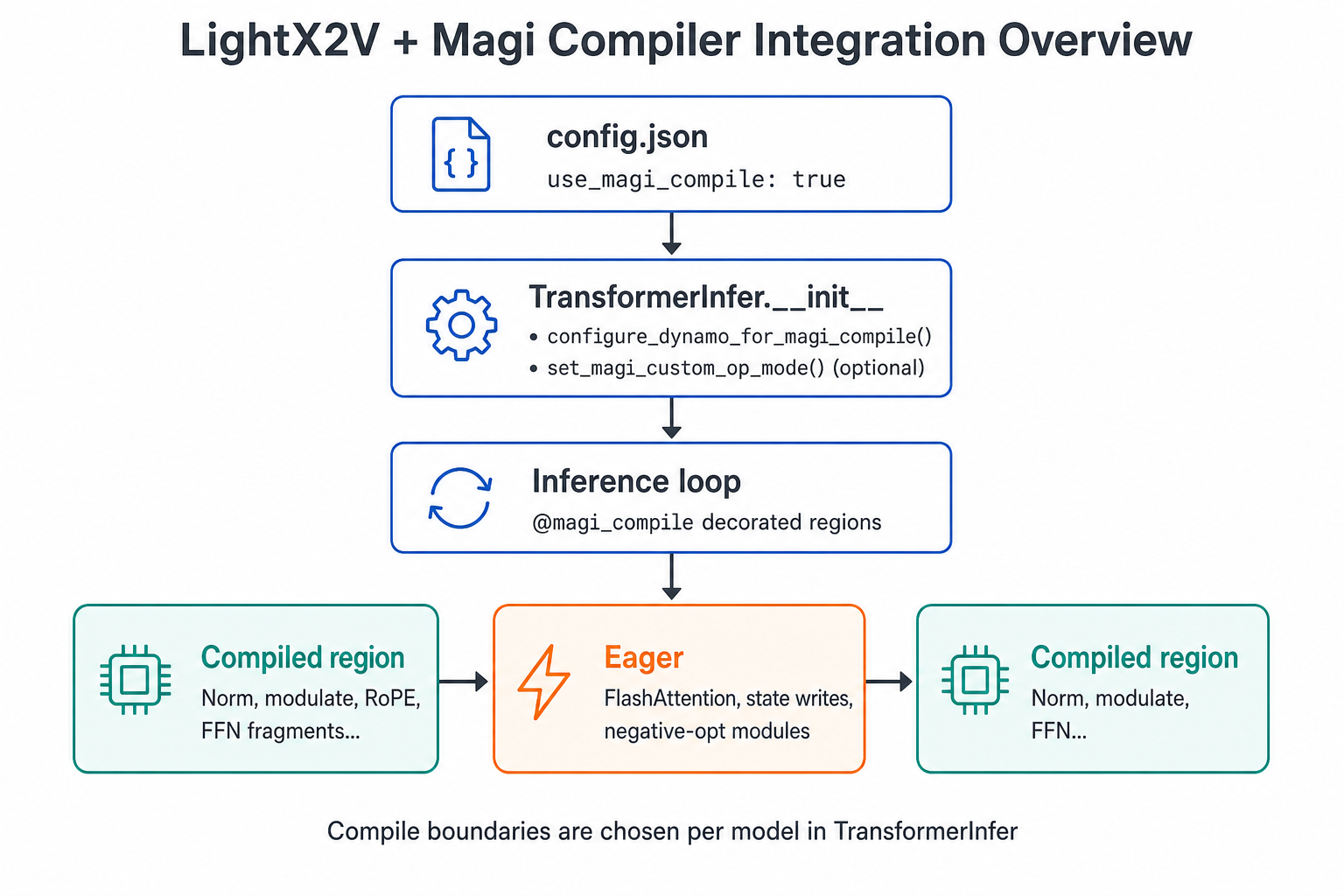
Figure 1: LightX2V + Magi Compiler integration overview.
As shown in Figure 1, Magi is enabled via use_magi_compile in config. Each model performs one-time setup in TransformerInfer.__init__; the inference loop runs paths decorated with @magi_compile. Green Compiled regions cover fusible small operator chains; orange Eager blocks are modules that do not participate in compile fusion. How many compile regions to use varies by model.
Core mechanisms
1. Declaring compile regions with @magi_compile
Decorate selected functions with @magi_compile, declare variable dimensions via dynamic_arg_dims, and tune compile behavior with config_patch. Example:
def _magi_config_patch(c):
    return c.model_copy(update={"disable_cache": True})

@magi_compile(
    dynamic_arg_dims={"hidden_states": 0, "freqs": 0},
    config_patch=_magi_config_patch,
)
def infer_region_magi(self, block, hidden_states, freqs, ...):
    return self.infer_region(block, hidden_states, freqs, ...)

for block in blocks:
    hidden_states = self.infer_region_magi(block, hidden_states, freqs, ...)
The main loop calls infer_region_magi instead of infer_region directly, matching the @magi_compile decorated regions in Figure 1’s inference loop.
2. Subgraph boundaries: isolating non-fusible ops inside compile regions
When Attention, state writes, or similar ops must live inside a compile region (e.g., an entire decoder layer wrapped in one decorator), the FX graph needs explicit cuts: mark ops Inductor must not cross using @magi_register_custom_op(..., is_subgraph_boundary=True) or splitting_ops, so those segments run eagerly or as opaque calls—the orange Eager boxes in Figure 1. Example:
@magi_register_custom_op(
    "magi_compiler::flash_attn",
    infer_output_meta_fn=["q"],
    is_subgraph_boundary=True,
)
def flash_attn_func(q, k, v):
    from flash_attn import flash_attn_func as fa2
    return fa2(q, k, v)
3. Shared configuration
When Magi is enabled, models also call during __init__:
configure_dynamo_for_magi_compile()for unified Dynamo settings;set_magi_custom_op_mode()where needed, so relevant ops use custom-op subgraph boundaries.
Users do not configure these separately—they take effect together with use_magi_compile: true.
Design principles
-
Shared framework infrastructure, per-model boundaries
Dynamo setup and custom-op mode live inlightx2v/common/magi_custom_op_mode.py;@magi_compilescope anddynamic_arg_dimsare designed per model. See Chapter 4 for porting new models. -
Transparent to users
Enable with"use_magi_compile": truein config (defaultfalse); ifmagi_compileris missing, log a warning and fall back to eager. -
Orthogonal and composable with other optimizations
Magi is an optional compile layer—it does not replace Attention/GEMM kernels, Triton, quantization, parallelism, or Offload, and can be combined with them. Whether to enable it and whether it helps should be decided by benchmark.
Benchmarks and Recommendations
How to enable
LightX2V’s official Docker image and requirements include magi_compiler. Set "use_magi_compile": true in the model config JSON and run inference as usual (e.g., python -m lightx2v.infer ...). Magi-related log lines confirm it is active; if the dependency is missing, a warning is printed and execution falls back to eager.
Performance data
Benchmark conditions: NVIDIA H100; metric is average infer_main latency per DiT step.
NeoPP (2K FP8, three-turn dialogue)
NeoPP is a recently integrated model whose small operator chains are not yet deeply Triton-optimized. Tests use 2048×2048 resolution, FP8 dense, three consecutive dialogue turns in one script; KV cache grows by ~4k tokens per turn. All statistics skip step 0.
Table 1 NeoPP three-turn dialogue infer_main latency (skip step 0)
| Turn | Magi ON | Magi OFF | Speedup |
|---|---|---|---|
| Turn 0 | 0.204 s | 0.250 s | 20% |
| Turn 1 | 0.240 s | 0.293 s | 17% |
| Turn 2 | 0.276 s | 0.335 s | 15% |
As Table 1 shows, Magi ON vs OFF yields a stable ~15%–20% gain across all three turns. As dialogue progresses, Attention share rises and small-op share falls, so relative speedup eases from 20% toward 15%.
Qwen Image (I2I, multi-resolution)
Qwen Image is a heavily optimized model in LightX2V with arbitrary-resolution image generation. Tests use I2I across representative H×W sizes. All statistics skip step 0.
Table 2 covers four config combinations, labeled triton_{on|off}_magi_{on|off}. The last three columns are three comparison metrics:
- Speedup ①:
triton_off_magi_on / triton_off_magi_off— Magi benefit on the Triton-OFF path - Speedup ②:
triton_on_magi_off / triton_off_magi_on— how close PyTorch + Magi gets to hand-tuned Triton (closer to 100% means closer totriton_on_magi_off) - Speedup ③:
triton_on_magi_on / triton_on_magi_off— marginal Magi benefit on the Triton-ON path
Table 2 Qwen Image I2I multi-resolution infer_main latency (skip step 0)
| H×W | triton_off_magi_off | triton_off_magi_on | triton_on_magi_off | triton_on_magi_on | Speedup ① | Speedup ② | Speedup ③ |
|---|---|---|---|---|---|---|---|
| 512×512 | 467 ms | 377 ms | 350 ms | 352 ms | 1.24× | 93% | 1.00× |
| 1024×1024 | 773 ms | 636 ms | 594 ms | 596 ms | 1.22× | 93% | 1.00× |
| 1328×1328 | 1083 ms | 907 ms | 850 ms | 854 ms | 1.19× | 94% | 0.99× |
| 928×1664 | 986 ms | 824 ms | 772 ms | 776 ms | 1.20× | 94% | 0.99× |
Speedup ① stays around ~1.2× across resolutions; ② is ~93%–94%—Magi alone clearly narrows the gap to hand-tuned Triton but remains slightly slower; ③ is near ~1.0×, so enabling Magi on top of Triton-ON does not yield stable extra benefit.
Qwen Image (single-process variable resolution)
Qwen Image supports arbitrary resolution. On compile-based serving paths, one worker often handles multiple H×W values; without proper dynamic-shape handling, a resolution change can trigger recompilation and sharply raise first-step latency. This section switches resolutions in one process with Magi ON, comparing first-step vs steady-state latency to verify that dynamic shapes can reuse compiled subgraphs in-process.
Table 3 Qwen Image single-process variable resolution infer_main latency (Magi ON)
| Phase | H×W | step 0 | steady avg |
|---|---|---|---|
| A (first) | 1024×1024 | 8751 ms | 603 ms |
| B (switch) | 768×1024 | 527 ms | 522 ms |
| C (switch) | 1328×1328 | 870 ms | 867 ms |
| A2 (switch back) | 1024×1024 | 607 ms | 609 ms |
The first 1024×1024 step 0 takes 8s+, mostly compile cost. After that, step 0 and steady avg stay close when switching resolutions; switching back to 1024×1024 does not reproduce the first-run compile spike.
Recommendations
- Pre-Triton is Magi’s main value zone—prioritize evaluation for new models or paths not yet hand-Triton-optimized.
- Magi significantly closes the gap to hand-tuned Triton, but a gap remains.
- After post-Triton deep manual optimization, do not enable Magi by default.
- For single-process variable resolution on compile paths, moving from raw
torch.compileto Magi has clear engineering value.
Porting Magi Compiler to a New Model
This chapter is for developers integrating Magi on new models: reusable assessment items and steps. Exact partitioning varies by model—use the reference implementations below as guides, not templates.
Pre-integration assessment
- Does Magi match your optimization stage?
- If the model is not yet hand-Triton-optimized and small ops are still mostly PyTorch (pre-Triton), evaluate Magi first.
- If the path is fully Triton-ized, expect limited benefit.
- What share do small operator chains have?
- With very long sequences and Attention-dominated steps, end-to-end Magi speedup may be limited.
- Which chains belong in compile vs eager islands?
- Dedicated hot kernels and ops Dynamo cannot stably trace or fuse are better kept as eager islands.
- Dynamic shapes (sequence length, resolution, etc.)?
- If dynamic shapes are involved, declare them via
dynamic_arg_dimsand consider variable-resolution tests.
- If dynamic shapes are involved, declare them via
Integration steps
Define compile regions
In the model’s TransformerInfer, pick paths with dense, fusible operator chains and decorate them with @magi_compile.
Set subgraph boundaries
For eager islands inside compile regions, cut the graph at those ops with @magi_register_custom_op(..., is_subgraph_boundary=True) or splitting_ops so Inductor does not fuse across them incorrectly.
Declare dynamic shapes
Configure dynamic_arg_dims on @magi_compile for tensor dimensions that vary with dynamic shapes. Avoid hiding variable dimensions in tuple arguments, self.xxx, or Python scalars, which can cause Dynamo to specialize.
Config and fallback
- Read
use_magi_compilefrom config; callconfigure_dynamo_for_magi_compile()when true. - Call
set_magi_custom_op_mode(True)if the model needs custom-op boundaries. - On init, warn and fall back to eager if
magi_compileris not installed.
Benchmark sign-off
After integration, benchmark with production-equivalent settings (same Triton, quantization, parallelism, etc.), comparing use_magi_compile: true vs false. Time single-step infer_main; for steady-state stats, skip step 0.
If the model has dynamic shapes (multi-resolution, variable sequence length, etc.), add a variable-resolution test: in one process, switch through representative shapes and confirm that—except for the first shape—step 0 latency matches steady state, with no abnormal recompilation.
Iterating compile boundaries with profiling
Optional fine-tuning: after an initial boundary layout, profile Magi ON vs OFF. If a segment regresses inside compile, a common cause is Inductor fusing across a boundary incorrectly or emitting a kernel worse than the dedicated or eager path—move that segment out of the compile region or add a subgraph boundary, then re-run sign-off.
Reference implementations
Examples already landed in LightX2V for @magi_compile, @magi_register_custom_op, dynamic_arg_dims, etc.; compile granularity varies by model.
-
SandAI LightX2V-MagiCompiler @3ed48d6 — Smallest change surface:
@magi_compiledirectly oninfer_without_offload, FlashAttention isolated via@magi_register_custom_op(..., is_subgraph_boundary=True); suited to pre-Triton models with regular block structure. -
LightX2V PR #1070 — Per-block
@magi_compile,dynamic_arg_dimsfor sequence length and cos/sin; KV cache writes isolated withsplitting_opsto prevent Inductor from fusing across updates. -
LightX2V PR #1089 — Multiple compile segments per block (before and after Attention), RoPE via custom-op boundaries;
dynamic_arg_dimsfor dual image/text streams and multi-resolution.
Limitations
- First-step compile latency: enabling Magi triggers graph compilation and codegen on the first step, which is much slower than steady-state steps.
- Mainline support: NeoPP and Qwen Image are validated and maintained in LightX2V mainline; other models require porting per Chapter 4.
- Other unverified scenarios: complex parallel combinations have not been systematically tested; complete numerical correctness and steady-state sign-off before production use.